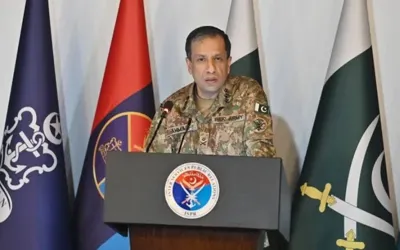
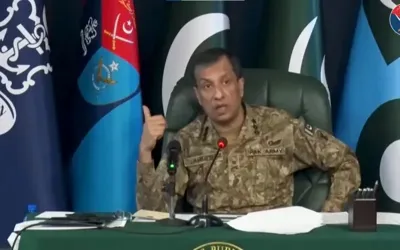
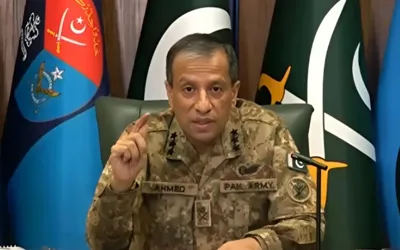
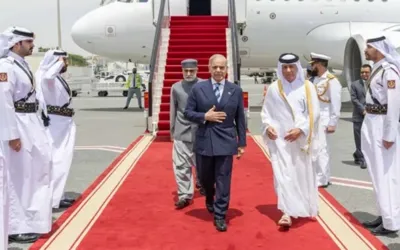
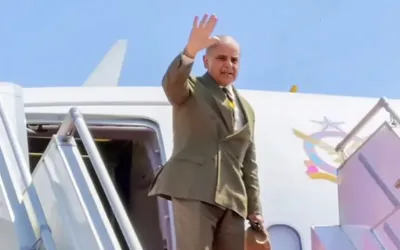
JAKARTA: Pakistan has delivered one of its strongest public assurances to Saudi Arabia, with DG ISPR Lt. Gen. Ahmed Sharif Chaudhry saying Islamabad is prepared to defend the Kingdom “to any extent” as Houthi attacks intensify and test the region’s new security arrangements.
Chaudhry told Arab News on Sept. 17 that Pakistan stands with Saudi Arabia both “diplomatically and physically,” stressing that its commitment to the Kingdom’s security is unconditional.
He said Pakistan would defend Saudi Arabia against any aggression and that its commitment extends to protecting Makkah and Madinah, Islam’s two holiest cities.
The assurance comes as Saudi Arabia faces repeated missile and drone attacks linked to Yemen’s Iran-aligned Houthi movement. An intercepted drone caused casualties in Taif, while Saudi authorities also reported a separate drone threat near restricted airspace around Makkah. Drones originating in Iraq have also damaged pumping stations along the Kingdom’s East-West Pipeline, according to Saudi authorities.
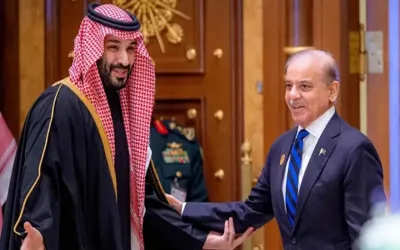
Pakistan’s commitment comes after the signing of the Makkah Joint Defense Agreement by Pakistan, Saudi Arabia and Türkiye on Aug. 7.
Under the pact, an armed attack against any one of the three countries is to be regarded as an attack against all three. Pakistan says the agreement is defensive in nature and intended to strengthen collective deterrence and regional stability.
The agreement builds on a Strategic Mutual Defense Agreement signed by Pakistan and Saudi Arabia in September 2025. The detailed operational provisions of both agreements have not been made public, leaving questions about the precise military response they would require.
Pakistan also maintains a military presence in Saudi Arabia, including troops and air-defense capabilities, according to Arab News.
Despite its firm defense pledge, Pakistan says it is continuing to pursue diplomacy to prevent the wider regional conflict from escalating further.
Chaudhry said Pakistan’s political and military leadership remains in regular contact with Saudi officials and is consulting regional governments in search of a negotiated and peaceful outcome.
Pakistan has also sought to mediate between Washington and Tehran. Chaudhry described the Islamabad Memorandum of Understanding as a framework for resolving the wider crisis, although subsequent negotiations have stalled amid renewed fighting.
Chaudhry also turned to Pakistan’s security concerns along its western border, saying Islamabad’s central demand from the Afghan Taliban is clear: Afghan territory must not be used for attacks against Pakistan.
The Pakistani military has repeatedly accused militant groups operating from Afghanistan of carrying out attacks inside Pakistan. Chaudhry has also said Afghan nationals were involved in most of the suicide attacks recorded in Pakistan during the first seven months of 2026. Those figures are claims by Pakistani military authorities and have been disputed by Afghan officials.
He said that if the Taliban authorities fail to fulfill commitments under the Doha agreement, Pakistan retains the right to defend itself.
On Balochistan, Chaudhry has rejected describing the violence as an insurgency, instead characterizing it as terrorism and saying militant groups lack broad public support. He said Pakistan is combining military operations with development, employment, public engagement and improved governance.
Pakistani military officials have also accused India of supporting militant activity in Balochistan and alleged that social media operations are being conducted from outside the country. Those allegations represent the Pakistani military’s position and have not been independently established in every case.
Chaudhry reiterated that Pakistan’s policy is not to negotiate with terrorist groups. In earlier remarks, he said militants would have to surrender and face accountability under Pakistani law.
Pakistan is therefore balancing two major security priorities: reinforcing its defense commitment to Saudi Arabia as regional attacks continue, while maintaining pressure on militant groups and addressing cross-border threats along its western frontier.