Tuesday, November 3, 2026
Watch Live
UPDATED
FUEL PRICE
03-NOV-2026
PETROL
▼ -3.40 PKR
Rs. 374.51/ltr
DIESEL
▼ -7.76 PKR
Rs. 395.20/ltr
Headlines
US midterms put Trump’s political standing to the test Federal govt announces reduction in petroleum prices Cyberattack affects dozens of supermarkets across Europe Simple egg white face mask for your skincare routine 'Meer-e-Karwan Tum Ho' conference highlights climate challenges Major tech companies resist Trump's latest tariff push against Vietnam Netflix crime thriller 'Collision Course' tops global charts after release Field Marshal Asim Munir, Liu Haixing discuss bilateral ties at GHQ Sindh bans CNG, LPG cylinders in school vans Bird flu outbreak spreads across US poultry farms, infects 1.32m birds Pakistan fined 5% of match fees for slow over-rate in tri-nation final Pakistan to deregulate LPG pricing, add targeted subsidies Pakistan explores tokenizing Eurobond debt, Finance Minister says Karachi to get first mechanical garbage transfer system Pakistan bound LNG carrier attacked near Strait of Hormuz despite Iranian clearance US consortium proposes $4.4 billion LNG project in Pakistan US midterms put Trump’s political standing to the test Federal govt announces reduction in petroleum prices Cyberattack affects dozens of supermarkets across Europe Simple egg white face mask for your skincare routine 'Meer-e-Karwan Tum Ho' conference highlights climate challenges Major tech companies resist Trump's latest tariff push against Vietnam Netflix crime thriller 'Collision Course' tops global charts after release Field Marshal Asim Munir, Liu Haixing discuss bilateral ties at GHQ Sindh bans CNG, LPG cylinders in school vans Bird flu outbreak spreads across US poultry farms, infects 1.32m birds Pakistan fined 5% of match fees for slow over-rate in tri-nation final Pakistan to deregulate LPG pricing, add targeted subsidies Pakistan explores tokenizing Eurobond debt, Finance Minister says Karachi to get first mechanical garbage transfer system Pakistan bound LNG carrier attacked near Strait of Hormuz despite Iranian clearance US consortium proposes $4.4 billion LNG project in Pakistan

Uber bets $1.25 billion on driverless future with Rivian deal

10,000 autonomous R2 robotaxis set to hit roads by 2028, signalling a major shift in urban mobility.

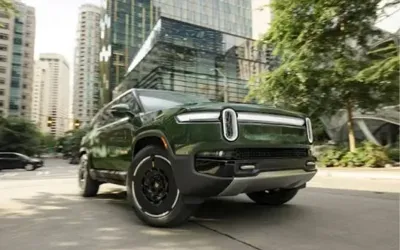
In a bold move set to redefine the future of mobility, Uber has announced a landmark investment of up to $1.25 billion in electric vehicle innovator Rivian signalling an ambitious leap towards a fully autonomous ride-hailing ecosystem.

At the heart of the partnership lies a plan to deploy 10,000 driverless Rivian R2 SUVs as robotaxis by 2028, ushering in a new era where human drivers may no longer be central to everyday transport. The initial rollout will target major urban hubs, including San Francisco and Miami, before expanding further.

The announcement sent Rivian’s shares soaring by nearly 9% in premarket trading, underscoring growing investor optimism around the accelerating shift towards autonomous mobility.

This collaboration arrives at a pivotal moment for the industry. After years of stalled progress, rapid advancements in artificial intelligence and deepening tech partnerships are reigniting confidence in driverless technology bringing solutions to complex road environments and high operational costs within closer reach.

While Rivian has yet to officially launch a robotaxi service, it has been quietly laying the groundwork. The company recently introduced its own advanced self-driving chip and is preparing to roll out its next-generation R2 SUVs designed to be more accessible, scalable, and commercially viable.

Under the agreement, Rivian’s R2 robotaxis will operate exclusively on Uber’s platform, with the ride-hailing giant retaining the option to expand its fleet by an additional 40,000 vehicles from 2030.

If successfully executed, the partnership could see thousands of fully autonomous, unsupervised robotaxis operating across 25 cities in the United States, Canada, and Europe by 2031 potentially transforming not just how people travel, but how cities themselves function.

Recommended