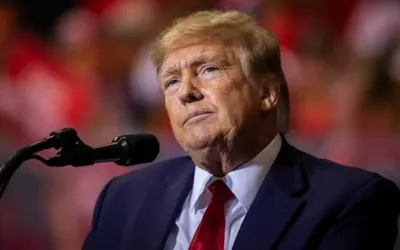
WASHINGTON: America’s 250th anniversary comes with an unusual new symbol: a $1 coin featuring President Donald Trump.
The coin entered circulation Wednesday, making Trump the first living president to appear on a circulating U.S. coin and raising questions over longstanding restrictions on presidential images on American currency.
The U.S. Mint said the 2026 President Donald J. Trump $1 coin is available for purchase and is also in circulation, meaning some could eventually turn up in everyday pocket change. The release is part of the U.S. Semiquincentennial coin program marking 250 years since the Declaration of Independence in 1776.
“Available for purchase today at 12PM ET: 2026 President Donald J. Trump $1 Coin. These coins are also in circulation, so check your pocket change. Collect them today!” the Mint said on X.
The front of the coin features a portrait of Trump along with the inscriptions “LIBERTY,” “IN GOD WE TRUST” and “1776 ~ 2026.” The reverse shows a version of the presidential seal, with an eagle holding an olive branch and a bundle of arrows and a shield bearing the number “250.”
The coin also carries the inscriptions “UNITED STATES OF AMERICA” and “ONE DOLLAR.” A banner in the eagle’s beak bears the Latin motto “E PLURIBUS UNUM,” meaning “Out of many, one.”
The Mint said 250,000 Trump $1 coins were struck July 4 at the Philadelphia Mint with a special July 4 privy mark. The coins were randomly placed in rolls and bags sold through the Mint’s online catalog.
A roll of 25 coins is being sold for $61, while a 100-coin bag costs $154.50. Both prices are significantly higher than the coins’ $1 face value, reflecting their initial collector-market pricing.
The release has attracted scrutiny because federal law generally prohibits the likeness of a living person from appearing on U.S. currency. The restriction has helped preserve a longstanding tradition of keeping sitting presidents off the nation’s money.
The Treasury Department did not immediately respond to a request for comment on whether the new coin complies with the law.
The Citizens Coinage Advisory Committee, a bipartisan panel that advises the Treasury secretary on coin designs, previously declined to review an earlier proposal for a Trump coin. Some members warned that issuing the coin without the panel’s review could violate federal requirements.
The coin also carries a notable historical distinction. In 1926, President Calvin Coolidge appeared alongside George Washington on a commemorative silver half dollar marking the 150th anniversary of the United States. It remains the only previous U.S. coin to feature a living president, but it was a commemorative issue rather than a circulating coin.
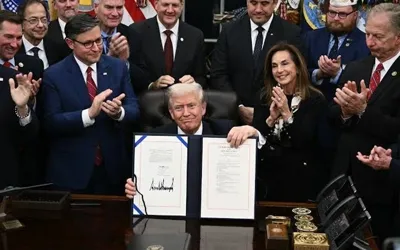
Trump’s appearance on currency is part of a broader effort during his second term to place his name and likeness on prominent national institutions and symbols. His administration has pursued major changes to the White House complex, including plans to replace the East Wing with a new ballroom, while his name has also been added to the Kennedy Center for the Arts.
The effort has extended to paper money. In May, Treasury Secretary Scott Bessent said the department was pursuing a proposal for a new $250 bill featuring Trump. Bessent acknowledged that Congress would need to change federal law before a living president could legally appear on such a bill.
The Treasury Department also announced in March that U.S. paper money would soon bear Trump’s signature, another departure from longstanding practice involving sitting presidents.
The new $1 coin was created to celebrate a major milestone in American history, but its release has also placed an old question back in the spotlight: how far can a sitting president’s image go in reshaping the symbols of the United States?