Wednesday, September 23, 2026
Watch Live
UPDATED
FUEL PRICE
21-SEP-2026
PETROL
-1.70 PKR
Rs. 392.05/ltr
DIESEL
-3.12 PKR
Rs. 418.96/ltr
Headlines
Gulf stocks edge higher on oil recovery, diplomacy hopes ‘Off Campus’ S2 wraps as leaked BTS footage shakes fandom fever Rising Opioid Use Disorder crisis hits older adults Pakistan develops 'Gender Tracker' to tackle online harassment of women Bahawalpur teen plays 'Breaking Bad', arrested for poisoning father with AI help Trump’s Board of Peace recovery blueprint sets $2.45B six-month plan to rebuild Gaza Rock world in shock as Rose Tattoo frontman 'Angry Anderson' dies at 79 Massive unexploded 'WW2' bomb found near Falmouth Docks Punjab boards announce Intermediate Part-II results 2026 PM appoints Hamza Farrukh as Pakistan Climate Change Authority chair Pakistan Navy, Coast Guards foil smuggling bid in Pishukan Saudi Arabia marks 96th National Day, highlights close Pakistan-Saudi partnership Pindiz owner warns of PSL exit over Rizwan Trump meets Venezuela’s Delcy Rodriguez on UNGA sidelines Shehbaz meets Bill Gates, reaffirms push to eradicate polio ADB forecasts Pakistan growth at 3.7% for FY2027, warns of middle east risks Prime Minister Shehbaz and DPM Dar ramp up diplomacy at UN General Assembly US F-16 crashes near German air base after training exercise Pakistan foils Afghan infiltration, responds to border fire Gulf stocks edge higher on oil recovery, diplomacy hopes ‘Off Campus’ S2 wraps as leaked BTS footage shakes fandom fever Rising Opioid Use Disorder crisis hits older adults Pakistan develops 'Gender Tracker' to tackle online harassment of women Bahawalpur teen plays 'Breaking Bad', arrested for poisoning father with AI help Trump’s Board of Peace recovery blueprint sets $2.45B six-month plan to rebuild Gaza Rock world in shock as Rose Tattoo frontman 'Angry Anderson' dies at 79 Massive unexploded 'WW2' bomb found near Falmouth Docks Punjab boards announce Intermediate Part-II results 2026 PM appoints Hamza Farrukh as Pakistan Climate Change Authority chair Pakistan Navy, Coast Guards foil smuggling bid in Pishukan Saudi Arabia marks 96th National Day, highlights close Pakistan-Saudi partnership Pindiz owner warns of PSL exit over Rizwan Trump meets Venezuela’s Delcy Rodriguez on UNGA sidelines Shehbaz meets Bill Gates, reaffirms push to eradicate polio ADB forecasts Pakistan growth at 3.7% for FY2027, warns of middle east risks Prime Minister Shehbaz and DPM Dar ramp up diplomacy at UN General Assembly US F-16 crashes near German air base after training exercise Pakistan foils Afghan infiltration, responds to border fire

Jashan e Karachi" Kicks off with 'Urdu Nazm mein Karachi ka Hissa’

Jashan e Karachi" Kicks off with 'Urdu Nazm mein Karachi ka Hissa’

Web Desk December 06, 2024 Add Bol News as a trusted source

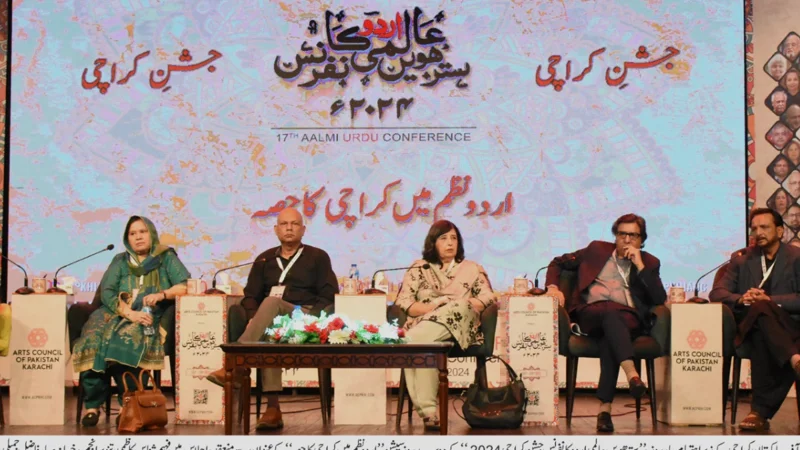
KARACHI: On the second day of the 17th Aalmi Urdu Conference, organized by the Arts Council of Pakistan Karachi, the first session titled “Urdu Nazm Main Karachi ka Hissa” was held.

The session was moderated by Salman Sarwat, while the panel of speakers included Rukhsana Saba, Dr Tanveer Anjum, Haris Khalique, Fazil Jamili, and Dr Faheem Shanas Kazmi.

The discussion focused on the significant contributions and new experiments in Urdu Nazm by Karachi-based poets after the creation of Pakistan, with particular emphasis on the development of Urdu Nazm during the 1950s, 60s, and 70s.

Rukhsana Saba highlighted that the poetry of this era prominently reflected the tragedy of migration and the sense of disconnection from one’s roots.

She referenced works by poets such as Josh Malihabadi, Mustafa Zaidi, Jamiluddin Aali, Himayat Ali Shair, Mohsin Bhopali, and Aziz Hamid Madani. Dr. Faheem Shanas Kazmi spoke about the contributions of Karachi-based poets to the genre of Nazm during the 1950s, describing this period as one marked by political turmoil and economic crises, deeply influenced by migration. She emphasized the contributions of notable figures such as Iftikhar Arif, Aziz Hamid Madani, Mohib Arifi, and Qamar Jamil, stating that their poetry represents the essence of that era.

Dr Tanveer Anjum commented on the 1960s, noting that the global shift beyond progressivism and the growing unrest were reflected in the poetry of the time.

The prose poetry of this era was rich with symbolism, representing a postmodernist approach, with Ahmad Hamish and Qamar Jamil standing out. Haris Khalique remarked that Urdu Nazm is a complete expression of a civilization.

He noted that, while fiction in Urdu did not achieve the same level of excellence, Nazm witnessed remarkable work. Free verse and prose poetry during this time mirrored global transformations.

Speaking about the development of Urdu Nazm during the 1970s, Fazil Jamili stated that the post-independence evolutionary journey of Urdu Nazm holds significant importance.

During this period, Nazm transitioned from progressivism to modernism and ultimately to prose poetry. The works of Zehra Nigah and Fehmida Riaz were highlighted, with Fehmida Riaz opening new avenues for women poets, giving rise to a new movement. This journey continued to poets like Zeeshan Sahil.


Recommended