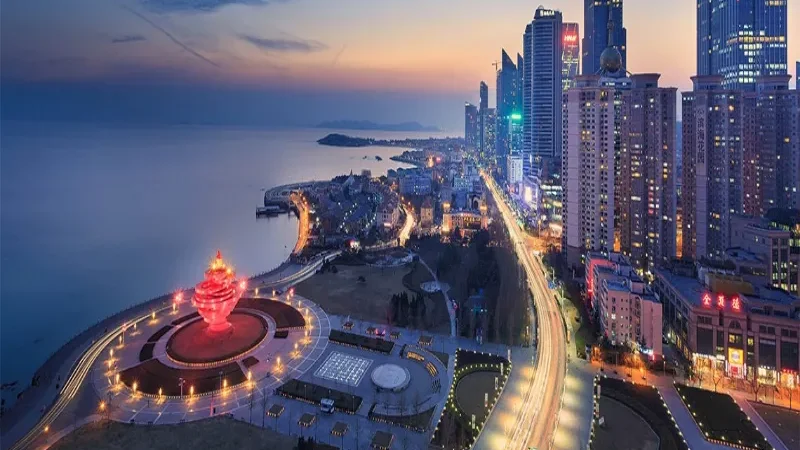
Shandong has emerged as one of China’s major economic powerhouses through a development approach that combines industrial strength, modern agriculture, advanced technology, efficient infrastructure, capable institutions and a growing services sector.
Home to around 101 million people, the eastern Chinese province has developed an economy of approximately $1.48 trillion, making it one of the country’s most significant regional economic centres. Its development story reflects decades of planning and a gradual transformation from a predominantly traditional economic base into a diversified and increasingly technology-driven economy.
A visit to Shandong provided an opportunity to observe the province’s development from several perspectives, including economic planning, manufacturing, agriculture, logistics, rural development, tourism, cultural heritage and workforce development.
One of the most striking features of Shandong’s economy is its diversification. Agriculture remains an important foundation, while manufacturing continues to serve as a major engine of growth and services have become an increasingly dominant part of economic activity.
The province is simultaneously developing industries associated with the future economy, including electric vehicles, semiconductors, lithium-ion batteries and advanced manufacturing. The combination of established industries with emerging technologies has allowed Shandong to pursue industrial upgrading without abandoning the economic sectors that have historically supported its growth.
Agriculture provides another important dimension of the province’s development model. Shandong is a major producer of grain, cotton, fruits and vegetables, but agricultural activity is not viewed simply in terms of crop production. A wider network has developed around farming that includes storage, cold-chain facilities, food processing, transportation, quality standards, marketing and access to domestic and international markets.
This creates an economic chain in which agricultural production feeds into processing and manufacturing, while logistics and marketing connect products with consumers. Such integration increases the value generated from agricultural output and creates employment and business opportunities beyond the farm itself.
The province has also placed considerable emphasis on technological transformation in manufacturing. Traditional industrial capacity is being supplemented by newer industries and more sophisticated production systems. Electric vehicles, semiconductors and battery technologies represent part of the broader shift towards high-value manufacturing.
The transformation reflects a wider change in the nature of industrial competitiveness, where technology, research, skilled labour and efficient production increasingly determine the value of manufactured goods. Institutions have played a central role in supporting this economic transformation.
Jinan, the provincial capital, functions as an important political, financial and educational centre. The city also provides a window into the role of public institutions in economic planning and coordination. Economic development requires more than investment and physical infrastructure. Planning institutions must be capable of identifying priorities, coordinating different sectors and implementing policies over the long term.
The development experience of Shandong demonstrates the importance of this institutional capacity. The province’s economic activity also extends beyond major urban centres. Jining offers a different but equally important perspective, with its strong agricultural, cultural and rural characteristics.
The city and surrounding counties demonstrate how smaller urban areas and rural communities can be connected with wider economic, tourism and transportation networks. This integration allows economic opportunities to spread beyond major metropolitan centres and creates stronger links between rural production and urban markets.
Culture has also been incorporated into Shandong’s economic development. Jining and the nearby area of Qufu are closely associated with Confucius and Mencius and have developed this cultural heritage into an important tourism and educational asset.
Historical sites are connected with visitor facilities, hospitality, transportation, cultural activities and local businesses, allowing cultural heritage to generate wider economic activity. The experience illustrates how history and culture can become part of a modern regional economy when they are supported by appropriate infrastructure and organised tourism services.
Connectivity is another defining element of Shandong’s development. As a major coastal province, Shandong has developed an extensive network linking ports with industrial areas, roads, railways, warehouses and production centres. The effectiveness of this system lies in the connections between its individual components.
A port becomes more economically valuable when it is efficiently connected to factories, agricultural production areas, storage facilities and transport networks. Similarly, industrial development gains greater momentum when manufacturers can move raw materials and finished products efficiently.
The province’s logistics network therefore functions as an integrated economic system rather than a collection of separate infrastructure projects. Human resources form another important pillar of the development strategy. The expansion of advanced manufacturing and modern services requires workers with practical, technical and specialised skills.
Vocational education and technical training consequently have an important role in preparing the workforce for changing economic requirements. Workplace cooperation and constructive labour-management relations also contribute to industrial stability and productivity.
Shandong’s experience suggests that investment in people is as important as investment in factories, roads and machinery. A modern economy ultimately depends on workers, technicians, managers, researchers and entrepreneurs who can operate and improve its economic systems.
The province’s development story is therefore best understood as a process of integration. Agriculture is connected with processing and logistics. Manufacturing is linked with technology and skilled workers. Ports connect production with domestic and international markets. Cultural heritage supports tourism and local businesses, while cities and rural areas are increasingly integrated into common economic networks.
This interaction between different sectors has created a broader economic ecosystem in which one area of development supports another. Shandong’s rise has not been the result of a single policy, project or industry. It reflects long-term planning, continuous industrial upgrading, modern agricultural systems, infrastructure development, institutional coordination, investment in human capital and the commercial development of cultural resources.
Its experience demonstrates that regional economic strength is built over time when different components of the economy are developed together. For Shandong, the challenge now is to sustain this momentum as technology, global markets and industrial structures continue to change.
Its growing presence in advanced manufacturing and emerging technologies suggests that the province is seeking not only to preserve its existing economic strengths but also to position itself for the next stage of development. Shandong’s development story ultimately offers a study of how a large and diverse region can transform its economic potential into a connected system of production, services, technology, agriculture, logistics and human capital.