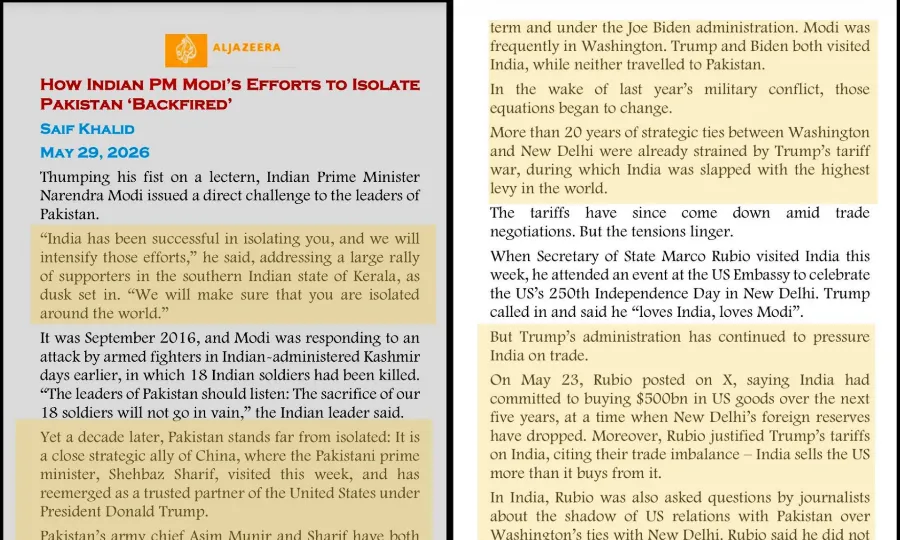
In a shifting geopolitical landscape marked by evolving alliances and intensified regional diplomacy, a recent Al Jazeera report suggests that India’s decade-long effort to diplomatically isolate Pakistan has not only fallen short of its intended objectives.
It has also coincided with Islamabad’s growing relevance across major global power centres.
According to the report, India under Prime Minister Narendra Modi pursued a more assertive foreign policy posture from 2016 onwards, aiming to limit Pakistan’s international space.
However, the analysis argues that the outcome has been contrary to expectations, with Pakistan instead maintaining and expanding its diplomatic engagement on multiple fronts.
The report notes that Pakistan today continues to engage actively with key global and regional powers, including the United States, China, Iran, and Saudi Arabia.
Rather than being pushed to the margins of regional politics, Islamabad is described as remaining a consistent participant in strategic and diplomatic discussions shaping regional stability.
Al Jazeera further states that Pakistan’s position has evolved from perceptions of diplomatic constraint to that of an active regional stakeholder, engaging simultaneously in multiple strategic partnerships and multilateral platforms.
Referring to recent regional developments, the report claims that during the 2025 Pakistan–India tensions, Pakistan’s narrative gained notable international attention, while several global capitals reportedly refrained from fully endorsing Indian claims in the absence of independently verified evidence.
It also highlights that Pakistan’s sustained diplomatic outreach, combined with its security and strategic engagements, has contributed to increased international visibility at a time of shifting global alignments.
Read More: Khawaja Asif mocks Afghan Government with Modi’s picture after border clash
On wider geopolitical dynamics, the report references differences in approach between Washington and New Delhi regarding credit for ceasefire-related developments, noting divergent public positions during periods of heightened regional tension.
The analysis underscores Pakistan–China relations as a key pillar of regional geopolitics, describing the partnership as a stabilising and enduring factor influencing strategic calculations across Asia.
In South Asia, the report points to improving ties between Pakistan and Bangladesh, describing it as a notable diplomatic development that has introduced new dynamics into regional engagement patterns.
The report also highlights Pakistan’s expanding defence and strategic cooperation with Gulf states, particularly Saudi Arabia, indicating emerging realignments in regional security and partnership frameworks.
Additionally, Pakistan’s defence posture and growing focus on economic diplomacy, including investment and mineral sector engagement, are noted as factors attracting increasing international attention.
The report also touches on concerns regarding India’s domestic policy environment, stating that issues related to minority rights and internal political developments have, in some contexts, drawn international scrutiny, though perceptions vary globally.
Experts cited in the analysis suggest that Pakistan’s ability to maintain balanced engagement with multiple major powers including the United States, China, Iran, and Saudi Arabia reflects a rare and complex diplomatic positioning in today’s global order.
Overall, the report concludes that instead of diplomatic isolation, Pakistan has remained actively engaged across global platforms, while broader geopolitical shifts continue to reshape influence and alignments across the region.