HONG KONG: Tung Chee-hwa, Hong Kong’s first leader after its return to Chinese rule, has died at 89, leaving behind a defining legacy from the city’s historic transition.
Tung died Tuesday night surrounded by family and loved ones, according to local media reports. His office described him as a man “devoted to his country and its people.”
He became Hong Kong’s leader in July 1997, succeeding British Gov. Chris Patten after Britain handed the territory back to China, ending more than 150 years of British rule.
His tenure was marked by economic turmoil, public health emergencies and growing political opposition. The Asian financial crisis struck soon after he took office, sending property prices sharply lower. His administration also faced a bird flu outbreak from 1997 to 2002 and the 2003 outbreak of severe acute respiratory syndrome, or SARS.
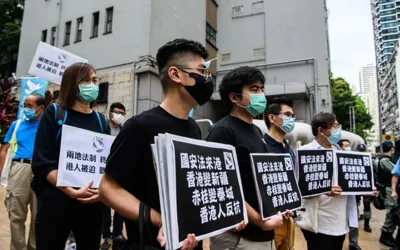
Tung faced his biggest political challenge in July 2003, when about 500,000 people took to the streets to protest proposed national security legislation. Critics feared the measure would threaten civil liberties and political freedoms.
The government eventually withdrew the legislation following the mass protests. Tung resigned as chief executive in March 2005, citing declining health. Some observers at the time said he had been pressured by Beijing to step down.
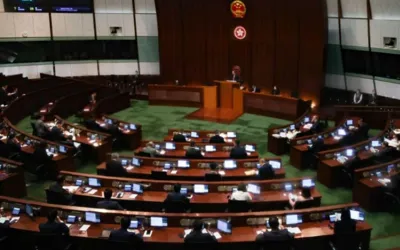
Beijing later imposed a national security law on Hong Kong in 2020. Chinese authorities said the law was necessary to maintain stability, while critics argued that it significantly curtailed political freedoms.
Born in Shanghai in 1937, Tung studied mechanical engineering at the University of Liverpool before moving to the United States, where he worked for General Electric for nearly a decade.
He returned to Hong Kong in 1969 and joined his father’s shipping company, Orient Overseas. Tung took over the business in 1979 and became a prominent figure in Hong Kong’s business community.
His political career began in 1992, when he was appointed to Patten’s Executive Council. Despite having limited political experience, Tung emerged as Beijing’s preferred candidate to lead Hong Kong after the handover.
A widely photographed encounter in January 1996 reinforced that perception. At a reception at Beijing’s Great Hall of the People, then-Chinese President Jiang Zemin crossed a crowded room to shake Tung’s hands, a gesture widely viewed at the time as a public sign of Beijing’s backing.
Tung’s relationship with Beijing had also drawn attention because Chinese state-run banks helped support his family’s shipping business during a global downturn in the mid-1980s.
After leaving Hong Kong’s top political post, Tung remained active in Chinese politics. He served as a vice chairman of the Chinese People’s Political Consultative Conference, China’s top political advisory body, for four consecutive terms.
His last reported public appearance came in July 2021 at an event marking the 100th anniversary of the founding of the Chinese Communist Party. He later underwent heart surgery, according to reports.
Former Hong Kong leaders paid tribute to Tung following news of his death.
Leung Chun-ying, who served as chief executive from 2012 to 2017, described Tung as a “benevolent” leader who “won people over with reason.”
Carrie Lam, who led Hong Kong from 2017 to 2022, said Tung’s leadership made “a historic contribution with lasting benefits.”
China’s state-run Xinhua news agency described Tung as a “renowned patriot” and “distinguished social activist,” while highlighting his long service in the Chinese People’s Political Consultative Conference.
Tung is survived by his wife and three children.