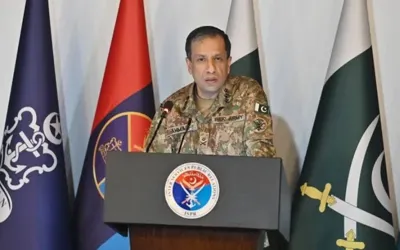
ISLAMABAD: Pakistan has sent its strongest message yet on Saudi Arabia’s security, with the country’s top military spokesman saying Islamabad is prepared to go “to any extent” to defend the Kingdom amid escalating regional tensions.
Lt. Gen. Ahmed Sharif Chaudhry, director general of Inter-Services Public Relations, made the remarks in an interview with Arab News on Thursday, saying Pakistan stands with Saudi Arabia both diplomatically and physically and will defend it against any aggression.
“Pakistan fully stands with the Kingdom of Saudi Arabia, both diplomatically and physically,” Chaudhry said. “We will go to any extent.”
Chaudhry said Pakistan’s commitment also extends to protecting Makkah and Madinah, Islam’s two holiest cities.
“There should be no doubt on that,” he said. “We will continue to defend Kingdom of Saudi Arabia against any aggression.”
He described the relationship between Pakistan and Saudi Arabia as a deep-rooted and historic bond linking the two countries’ people, military forces and political leadership.
“Our commitment to Saudi security is unconditional,” Chaudhry said.
His remarks come as Saudi Arabia faces repeated missile and drone attacks by Yemen’s Iran-aligned Houthi movement. An intercepted drone caused falling debris to kill one person and injure two others in Taif on Thursday, while Saudi authorities have also reported attacks involving restricted airspace near Makkah.
The statement comes just over a month after Pakistan, Saudi Arabia and Türkiye signed the Makkah Joint Defense Agreement on Aug. 7.
The pact says an armed attack against any one of the three countries would be treated as an attack against all three. However, the agreement’s full operational provisions have not been made public, leaving questions about the specific military response it would require.
Pakistan already maintains a significant military presence in Saudi Arabia. Reuters previously reported that Islamabad deployed about 8,000 troops, JF-17 fighter jets, drones and an HQ-9 air defense system to the Kingdom in May.
Chaudhry did not say whether Riyadh had made a new request for additional Pakistani troops, air defense systems or direct military participation against the Houthis. He also did not confirm whether Pakistan’s nuclear deterrent falls under its defense commitments to Saudi Arabia.
While reaffirming its defense commitment to Riyadh, Islamabad is also pursuing diplomatic efforts to prevent the wider regional conflict from spreading.
Chaudhry said Pakistan’s political and military leadership remains in regular contact with Saudi officials and that Islamabad is consulting governments across the region to seek a negotiated and peaceful solution.
Pakistan has also been working to facilitate a return to negotiations between Washington and Tehran. Chaudhry said the Islamabad Memorandum of Understanding reached in June provides what Pakistan considers a viable path out of the current crisis.
Despite mistrust and obstacles to the process, he said Islamabad would continue looking for common ground between the two sides.
Pakistan’s dual approach maintaining its defense commitment to Saudi Arabia while pursuing dialogue with regional actors comes as Islamabad faces pressure to balance its longstanding ties with Riyadh with its efforts to engage Tehran and support de-escalation.