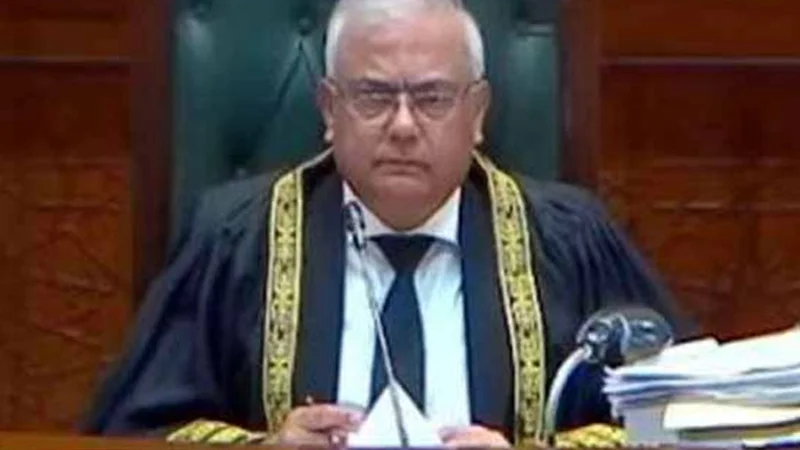
ISLAMABAD: The chief justice of Pakistan's Federal Constitutional Court stressed the importance of constitutional supremacy on Tuesday, saying all public authority must operate within constitutional boundaries.
"The Constitution must remain supreme and every exercise of the public authority must remain within its constitutional boundaries," Chief Justice Aminuddin Khan said at an event in Islamabad.
He described the Constitution as the "supreme expression of the collective will of the people" and said institutions created under it derive their authority from it and remain subject to its limits.
The FCC was established under the 27th Constitutional Amendment, passed in November 2025. Aminuddin called its creation "an important institutional development in the constitutional history of Pakistan."
He said constitutional adjudication occupies a "unique position in the administration of justice," addressing not only disputes between individuals but also questions involving the structure of the state, the distribution of constitutional powers, the protection of fundamental rights and the preservation of constitutional order.
The chief justice said the court did not inherit a fully developed institutional infrastructure when it was created.
"We had to build an institution while simultaneously performing the judicial responsibilities entrusted to us by the Constitution," he said. "In many respects we began our journey from scratch."
He noted there was no prolonged period of institutional preparation before the court began its work.
"The court was established, the judges took their oath and the constitutional responsibility of adjudication commenced," he said.
Three benches began work on the day the judges took their oath, Aminuddin said, calling that moment "a powerful reminder of the spirit with which this institution was born."
The FCC initially operated from the Islamabad High Court building before moving to its current premises, formerly occupied by the Federal Shariat Court. Aminuddin described the transition as "a formidable institutional exercise."
He said the building was constructed about 46 years ago and was originally designed to accommodate around 100 employees, but nearly 400 officers, officials and attached staff now work there.
"Space is limited. Facilities are under considerable pressure," he said, noting that some officials work in improvised cabins and compact work stations.
"Yet, despite these physical limitations, the work has continued and it has continued because institutions are ultimately not built by the concrete and bricks alone," Aminuddin said. "Institutions are built by people. They are built by commitments."