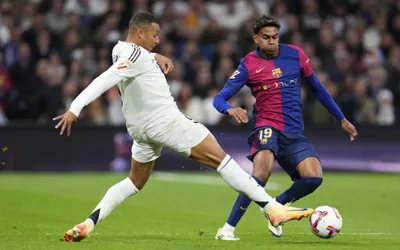
BEIJING: French soccer star Kylian Mbappé is facing mounting fallout in China over remarks that appeared to refer to Mao Zedong as a dictator, with sponsors cutting ties and broadcasts of Spanish league games disrupted.
China's state broadcaster CCTV said Oct. 27 that Mbappé's apology would ultimately be judged by his actions. "We will listen to his words, but watch his actions even more closely," an unnamed China Media Group representative said, urging Mbappé, Real Madrid and La Liga to learn from the incident.
A day earlier, the broadcaster suspended its La Liga coverage and matches involving the Real Madrid forward, and pulled advertisements in which he appeared. His accounts on the social media platforms Xiaohongshu and Weibo were subsequently muted, according to Renmin Ruiping, the online commentary platform of People's Daily.
As of Oct. 28, neither a resumption of broadcasts nor a lifting of the account restrictions could be independently confirmed.
The backlash followed the circulation of a clip from the French program "The Bridge," in which Mbappé discussed a meme that superimposed his face onto an image of Mao, the late Communist Party chairman and founding leader of the People's Republic of China. In the clip, Mbappé said the funniest meme he had seen of himself showed his face on that of "some guy — I think he's a Chinese dictator," Reuters reported. Reuters said it could not independently authenticate the video.
Mbappé apologized in Chinese, French and English in a statement on X on Oct. 27, acknowledging that his comments were ill-judged and had hurt many Chinese communities around the world.
"I have deep respect for the Chinese people and their history, and I am sincerely sorry," he wrote.
La Liga also issued a statement expressing deep regret over the hurt caused to Chinese fans and saying Mbappé's personal views do not represent the league's position.
Commercial fallout was swift. Dongpeng Beverage, dairy company Mengniu and cheese maker Milkground announced the end of their partnerships with Mbappé, according to company statements compiled by China.org.cn, a state-run web portal. Dongpeng's sports drink brand Bushuila had introduced him as its ambassador only in April.
Swiss sportswear brand On and fashion house Dior also reportedly removed Chinese promotional content featuring Mbappé, according to the Chinese news outlet Phoenix, though neither had announced a global termination.
Mbappé had about 1 million followers each on Xiaohongshu and Weibo. Reuters reported that four topics related to him ranked among Weibo's top 10 searches on Oct. 27.
People's Daily, the official newspaper of the Communist Party's Central Committee, added to the criticism through Renmin Ruiping. The commentary argued that celebrities who cross public boundaries can become liabilities for brands, and that profiting from a market while offending its people's cherished history and culture would not be accepted.
Foreign Ministry spokesman Guo Jiakun also addressed the controversy, saying the ministry was aware of the reports.
"Words and actions that hurt the feelings of the Chinese people will naturally be met with joint opposition from all sectors of Chinese society," he said.