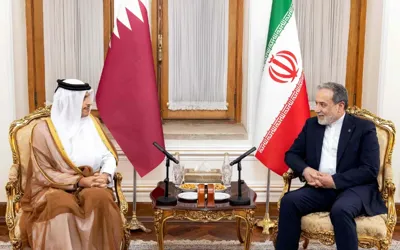
Qatar’s Prime Minister and Foreign Minister Sheikh Mohammed bin Abdulrahman Al Thani called Sunday for a regional security framework that would bring Gulf countries and Iran together. He said the recent war should be a “wake-up call” for the region.
“We are hoping that this war is a wake-up call for everyone that it’s time for it to happen,” Al Thani said while speaking at the Qatar Economic Forum on the sidelines of the 81st U.N. General Assembly in New York.
He said the recent regional crisis had challenged existing views about security and stability and had consequences beyond the Middle East.
“Iran is our neighbor,” Al Thani said. “We need to understand that without having a security framework that brings us all together as Gulf countries with Iran, ensuring that none of us is posing a threat to the other, this region will not just be continuing in the same way as it used to be.”
“We have to act together responsibly as a region and make sure that we are having good relations with Iran and Iran has good relations with the Gulf countries,” he added.
Al Thani said Qatar and its regional partners were working to establish such a framework. He expressed hope that the conflict would encourage greater cooperation among countries in the region.
“We are working toward that. Our regional partners believe in this, and we are hoping that this war is a wake-up call for everyone that it’s time for it to happen,” he said.
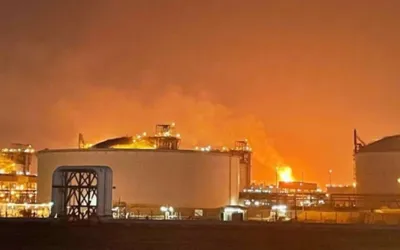
Sheikh Mohammed described the economic impact of the U.S.-Israel war on Iran as “an earthquake” whose “shock waves” had spread far beyond the Middle East and challenged assumptions about security and stability.
He said Qatar had managed to withstand the pressure on the foundations of its economy and security but acknowledged that the ongoing regional conflict was having an impact.
“Permanent security cannot be built through arrangements that leave any state permanently exposed to insecurity,” Sheikh Mohammed said. “We must address the sources of tensions and build confidence.”
He also said Qatar would continue its mediation efforts, keep communication channels open and work with regional and international partners to reduce tensions and support diplomatic agreements.
The remarks came as world leaders gathered in New York for the high-level week of the U.N. General Assembly. The war involving the United States, Israel and Iran, along with its regional consequences, was among the key issues facing Gulf countries.
The situation in the Middle East and its wider global impact are expected to remain major topics during speeches and diplomatic discussions.