ISLAMABAD: Pakistan accounts for 48% of the extreme poor in the Middle East, North Africa, Afghanistan and Pakistan region, with its poverty rate surging 6.4 percentage points between 2018-19 and 2024-25, the World Bank said in a report released Tuesday.
The report, titled “Middle East, North Africa, Afghanistan and Pakistan Economic Update, from Divide to Opportunity: AI, Jobs, and Growth,” found that MENAAP is now the only region in the world where poverty remains above pre-pandemic levels and continues to rise, with Pakistan driving much of the deterioration.
“The increase was driven primarily by a rise in poverty in Pakistan, where the poverty rate rose by 6.4 percentage points at the USD 3.00 per day line and 3.2 percentage points at the USD 4.20 per day line,” the report said.
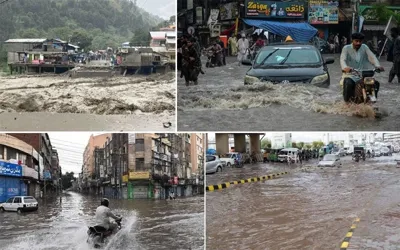
The bank attributed the increase to a succession of adverse shocks: the COVID-19 pandemic, the devastating 2022 floods, a macroeconomic crisis marked by high inflation and currency depreciation, and a prolonged period of economic adjustment that weakened real household incomes and employment opportunities.
According to the report, 14.3% of MENAAP’s population lived on less than $3 a day in 2024, compared with 10.4% globally, while 26.9% lived below the $4.20-a-day line against 18.9% worldwide.
Pakistan’s share of the region’s extreme poor is substantially larger than that of other countries. Afghanistan, the Syrian Arab Republic and Yemen together accounted for another 47% of people living below the $3-a-day threshold.
The World Bank projected that adverse poverty trends in MENAAP would persist through 2026, with poverty increasingly concentrated in conflict-affected and fragile economies.
Economic Outlook
The bank projected Pakistan’s GDP growth at 3.8% for 2027, below the government’s 4% target. Growth is expected to increase from 3.2% in fiscal year 2024-25 to 3.7% in 2025-26 as services, manufacturing and livestock remain resilient despite rising import costs.
Inflation is projected to rise to 8.2% in 2027 from 7.1% in 2026. Pakistan’s real GDP per capita growth is projected to improve marginally from 1.6% in 2025 to 2.1% in 2026 and 2.2% in 2027.
The current account balance is projected to deteriorate from a surplus of 0.5% of GDP in 2025 to deficits of 0.1% in 2026 and 0.8% in 2027, while the fiscal deficit is projected to narrow sharply from 5.4% of GDP to 2.6% in 2026 before widening to 3.5% in 2027.
The report warned that a prolonged slowdown in tourism, construction and related services could reduce labor demand and weaken income flows to labor-sending economies, particularly Pakistan and parts of the Levant.
Pakistan remains vulnerable to wider economic and climate shocks. Inflation rose to around 11% by midyear, while gasoline prices increased by 40% or more following the escalation of international energy prices. Diesel prices have risen by more than 40% since the start of the conflict. Pakistan has introduced targeted fuel and farm assistance to cushion vulnerable households and sectors.
The bank said targeted transfers were generally more efficient than broad subsidies and could help preserve fiscal space, particularly in countries facing significant debt and financing pressures.
AI Potential and Challenges
The report identified Pakistan, along with Egypt, Jordan, Morocco and Tunisia, as having technical talent and growing digital ecosystems but significant gaps in AI readiness.
Pakistan’s national AI strategy envisages training 200,000 individuals annually, including through 3,000 postgraduate scholarships, the largest absolute annual training target among the national AI strategies examined by the report.
The country’s AI ambition also includes a $1 billion program through 2030 covering shared GPU infrastructure, a sovereign multilingual model, 1,000 AI PhD scholarships and training for one million non-IT professionals.
Pakistan is seeking to build on an estimated 75,000 annual IT graduates and record ICT services exports of $4.6 billion in FY2025/26, with AI increasingly viewed as a potential source of productivity, exports and employment.
However, the World Bank cautioned that Pakistan’s AI opportunity could remain constrained by weak innovation and economic integration despite relatively strong digital infrastructure compared with income peers.
Only 3% of firms in Pakistan reported product innovation and 1% process innovation, compared with lower-middle-income peer averages of 23% and 14%, respectively.
The report also identified a major localization challenge. Urdu accounts for only 0.03% of global URLs collected by Common Crawl, compared with 0.7% each for Arabic and Persian, limiting the availability of local-language material for AI systems.
Frontier AI models perform broadly similarly when responding to English and Urdu prompts, the report said, but are less accurate on Urdu-centered humanities subjects, highlighting the shortage of culturally and linguistically relevant training data.
The World Bank said Pakistan’s AI adoption would require simultaneous progress in digital connectivity, electricity, skills, local data, institutional capacity, regulation and private-sector investment.
It noted that AI could increase productivity in an estimated 13-20% of jobs across MENAAP, while near-term automation threatened less than 10% of jobs. However, the benefits were likely to be uneven because educated, urban and non-wage workers dominate AI-exposed occupations.
Pakistan also remains exposed to infrastructure constraints. Mobile broadband subscriptions are below the benchmark for economies with comparable income levels, while significant portions of the population still face inadequate access to electricity.
The report suggested that “small AI”, affordable, purpose-built applications capable of operating on basic mobile devices, low-bandwidth connections and intermittent power, could provide infrastructure-constrained economies such as Pakistan with a practical route to AI adoption. Such applications could be deployed in agriculture, health and education without the computing capacity and continuous connectivity required by frontier AI systems.
The World Bank also highlighted Pakistan’s relatively strong performance in online public-service delivery, suggesting the country could experiment with AI-enabled government services.
Pakistan is also directly exposed to changing monsoon conditions, while climate-related heat stress and flood risks are adding to the country’s vulnerability, the report said.