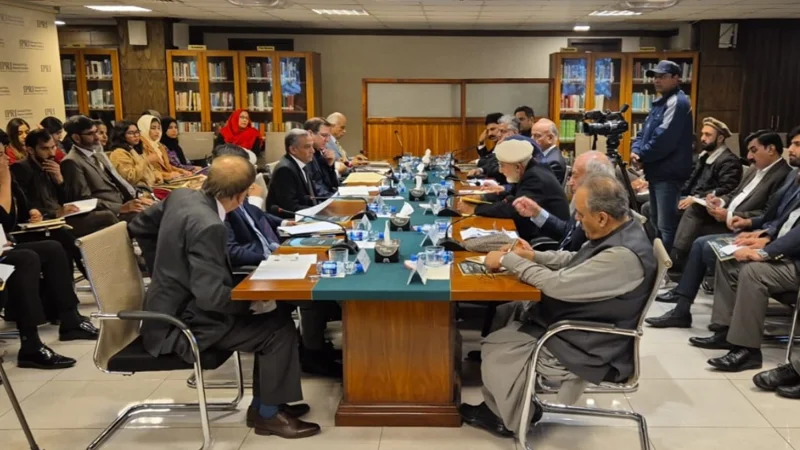
ISLAMABAD: A roundtable discussion was held at Islamabad Policy Research Institute (IPRI) on the need for new provinces to improve the governance and public service delivery on Wednesday. A very impressive cast of politicians, public policy practitioners, academics, and media attended the roundtable.
The speakers urged the need for adopting an organic solution to the prevailing administrative and governance problems in the country, and were of the view that creating new provinces is sine qua non for public good and in national security.
It was opined that the province of Punjab is larger than 196 countries. That prompts either redrawing of boundaries and redistribution of resources, if present day discord has to be addressed with the growing needs and necessities of a swelling population.
Some of the logical options on the table are either to convert administrative units into new provinces or merge several districts into new provinces.
It was also noted that regional political elite is one of the biggest obstacles on its way, as they see creating of new provinces as detrimental to their interests. Likewise, the regional parties do not see from the same prism with the mainstream political parties, pushing the issue in limbo. It was stated that a viable way is to let the parliament lead from the front through formation of a commission or more viable will be the formation of a parliamentary committee to create new provinces after threadbare consultations by taking onboard all the stakeholders from media to intelligentsia.
President IPRI Amb Dr Raza Muhammad opened the dialogue, and the discussion was moderated by Director Research IPRI, Dr Raashid Wali Janjua, who highlighted the administrative, economic and political factors that necessitated new provinces.
The participants elucidated that the delivery of public goods like law and order, civic amenities, and infrastructure development would improve significantly if the existing administrative divisions were converted into new provinces.
According to Daniyal Aziz a very important governance element was the empowerment of people at local government level, which would get facilitated by devolution of powers to local governments. The downside could be the country’s departure from the federalism and transition towards the unitary polity, entailing national consensus and constitutional amendments.
According to former bureaucrats like Shakeel Durrani and Ishtiaq Ahmed, the existing administrative “Divisions” could very effectively function as the new provinces with manageable size for efficient and economical public service delivery. According to them the bottom-up approach of governance through effective local governments with true fiscal and political devolution of powers would be facilitated through new provinces carved out of existing administrative divisions of the country.
The participants of the roundtable were of the view that if countries like Afghanistan, Indonesia, and Turkey could have 34, 38, and 81 provinces, then Pakistan would also be better served through more provinces.
It was observed that the root of the problem is that the governance system has lacked an effective local government module, and the same has been a victim of interference and lack of schedules to demark powers. That had led to maneuvering from senior bureaucracy grinding down to more chaos and problems. Similarly, clear stipulation of finances is another reason for the prevailing unrest among the administrative units.