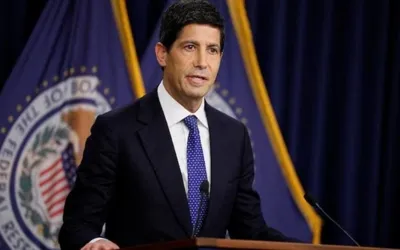
ISLAMABAD: Pakistan's securities regulator urged the insurance industry Tuesday to embrace digital transformation, saying technology is essential to expand coverage, speed up claim settlements and make affordable policies accessible to a public that remains largely uninsured.
Dr. Kabir Ahmed Sidhu, chairman of the Securities and Exchange Commission of Pakistan, told an SECP Talk Series session on the development and digitalization of the country's insurance market that the industry holds roughly 4 trillion rupees ($14 billion) in assets and collects 708 billion rupees ($2.5 billion) in annual premiums — yet insurance penetration stands at just 0.7% of GDP.
"Only 0.85 percent of insurance premiums are currently generated through digital channels, which shows both the scale of the challenge and the substantial opportunity available to the industry," Sidhu said.
He announced that an "Insured Pakistan" digital platform would be established to improve public access to insurance products and information, and said regulatory reforms were being introduced to ensure timely, transparent and fair claim settlements. Artificial intelligence and other emerging technologies are reshaping businesses globally, he said, and Pakistan's insurance industry must adopt them to stay competitive.
Sidhu singled out the weak enforcement of mandatory third-party motor insurance, saying an estimated 97% of vehicles in Pakistan operate without coverage. He said the SECP is working with the Punjab provincial government to strengthen enforcement through digital verification, adding that effective implementation could increase third-party motor coverage by as much as 2,000%.
Muhammad Aminuddin, chief executive of TPL Insurance, said coordinated regulatory and provincial action could bring all vehicles under insurance coverage by 2030. Integrating insurance records with vehicle registration and enforcement systems would simplify verification and improve compliance, he said.
Shoaib Javed Hussain, chief executive of State Life Insurance Corporation of Pakistan, said the country has 42 insurers and the sector has paid about 450 billion rupees ($1.6 billion) in claims. Life insurance and family takaful account for 462 billion rupees in annual premiums, 373 billion rupees in claims and 3.30 trillion rupees in assets, while non-life insurance and general takaful hold 245 billion rupees in premiums, 70 billion rupees in claims and 720 billion rupees in assets.
Hussain said the industry could mobilize between 200 billion and 500 billion rupees for infrastructure development, calling it a potential source of long-term capital for the economy.
Muhammad Ali Ahmed, chief executive of EFU Life Assurance, said pension fund assets reached 156 billion rupees by August 2026, a 333% increase since January 2021. But active voluntary pension accounts totaled only 143,000 as of December 2025, he said, even though Pakistan has a working-age population of 134.4 million.
Ahmed called for the development of retirement plans, voluntary pension schemes, annuities and insurance-based long-term savings products, saying long-term securities would further strengthen the pension market.
Participants agreed that digitalization, artificial intelligence, stronger enforcement, efficient claim settlement and innovative retirement products could significantly expand insurance coverage and strengthen the industry's contribution to economic resilience.