WASHINGTON: AI is racing into the battlefield faster than diplomacy can keep up, raising fears that one automated mistake could push the U.S. and China toward a global catastrophe in the blink of an eye.
An artificial intelligence system interfering with a nuclear command network by launching a military cyberattack could leave the United States and China with only minutes to determine whether the other side has launched an attack, U.S. and Chinese security experts warn.
The warning comes as rapidly advancing autonomous military technology raises new concerns that machines could accelerate a crisis faster than human officials can understand or contain it. Experts involved in a U.S.-China dialogue are calling for both countries to establish clear limits on how artificial intelligence can be used in military operations, particularly around nuclear weapons, command systems and critical infrastructure.
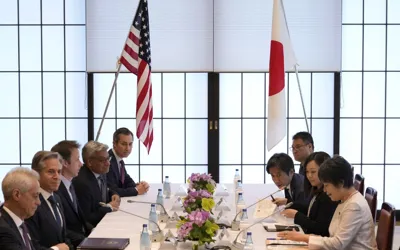
Their recommendations include keeping humans in control of major military decisions and creating a dedicated hotline to handle AI-related incidents. The proposals were developed through a bilateral track-two dialogue involving experts from the Brookings Institution and Tsinghua University. The recommendations were released ahead of planned government-level discussions on AI and an expected meeting between U.S. President Donald Trump and Chinese President Xi Jinping.
Melanie Sisson of the Brookings Institution said humans should retain sole authority to initiate AI-enabled cyberattacks against another country's nuclear command, control and communications systems or strategically important infrastructure.
Tianjiao Jiang, an associate professor at Fudan University, proposed similar restrictions, including rules preventing AI from independently deciding to use nuclear weapons or attacking nuclear command systems without human authorization.
The proposed safeguards would also cover critical sectors such as energy, finance and health care. Jiang called for the United States and China to agree on a common definition of "meaningful human control." Without a shared standard, both countries could claim that humans remain in control while allowing very different levels of machine autonomy.
The experts also warned that automated military systems could create a dangerous chain reaction. A defensive AI system could automatically respond to suspicious activity. The other country, however, might interpret that automated response as an intentional attack and launch its own retaliation before officials have enough time to determine what actually happened.
Jiang proposed establishing a dedicated U.S.-China military hotline for AI-related incidents. Such a communication channel could give officials a way to clarify whether an unexpected operation was accidental, unauthorized or still under investigation before it is treated as a deliberate military action.
The proposal comes with an existing challenge: experts have questioned how effectively the current U.S.-China military communication channel can operate during fast-moving crises.
The recommendations build on a principle endorsed by then-President Joe Biden and Xi in November 2024 that humans should maintain control over decisions involving the use of nuclear weapons.
The latest proposals expand that principle to a broader AI-era battlefield, where autonomous systems could influence cyber operations, military networks and other strategically sensitive infrastructure. Neither Washington nor Beijing has formally adopted the recommendations.
China has increasingly incorporated military AI issues into its existing arms-control structure, while the United States handles AI-related national security policy across several agencies, including the White House National Security Council, State Department and Pentagon.
Both governments also remain cautious about restrictions that could slow their technological development. The United States has expressed concerns that broad limits could strengthen China's position, while Beijing has criticized some U.S. technology restrictions as efforts to maintain American dominance.
As fears grow that the race for AI supremacy could be hurtling us all toward a grim fate not unlike the apocalyptic plot line of the Terminator movies, analysts told that mutual distrust between the U.S. and China, as much as the technology itself, could lead humanity "off a cliff."
China, one of the world's major centers for artificial intelligence development alongside Silicon Valley, is also facing growing concerns about AI safety.
Last week, a team of U.S. researchers used artificial intelligence to identify a security weakness in WeChat, China's widely used messaging and social media platform. The app is used by more than 800 million people in China, highlighting the potential impact of AI-related security threats.
Many Chinese technology companies also support the growing push for stronger AI regulations, according to Leia Wang, a non-resident scholar at the Carnegie Endowment for International Peace. She pointed to the Artificial Intelligence Laboratory in Shanghai as an example of a respected organization working to improve AI safety.
Yi Zeng, dean of the Beijing Institute of AI Safety and Governance, also warned about the risks in a research paper shared with CBS News. He said the dangers posed by AI are increasing and could eventually create serious risks for humanity.
Meanwhile, Britain's King Charles III is expected to bring together technology and industry leaders in Scotland on Thursday to discuss whether countries and companies can agree on common principles for the future development and use of artificial intelligence.
For experts, the central concern is not simply how powerful AI becomes, but whether diplomacy can move quickly enough to establish safeguards before autonomous systems begin making decisions at machine speed.