Wednesday, September 23, 2026
Watch Live
UPDATED
FUEL PRICE
21-SEP-2026
PETROL
-1.70 PKR
Rs. 392.05/ltr
DIESEL
-3.12 PKR
Rs. 418.96/ltr
Headlines
Rising Opioid Use Disorder crisis hits older adults Pakistan develops 'Gender Tracker' to tackle online harassment of women Bahawalpur teen plays 'Breaking Bad', arrested for poisoning father with AI help Trump’s Board of Peace recovery blueprint sets $2.45B six-month plan to rebuild Gaza Rock world in shock as Rose Tattoo frontman 'Angry Anderson' dies at 79 Massive unexploded 'WW2' bomb found near Falmouth Docks Punjab boards announce Intermediate Part-II results 2026 PM appoints Hamza Farrukh as Pakistan Climate Change Authority chair Pakistan Navy, Coast Guards foil smuggling bid in Pishukan Saudi Arabia marks 96th National Day, highlights close Pakistan-Saudi partnership Pindiz owner warns of PSL exit over Rizwan Trump meets Venezuela’s Delcy Rodriguez on UNGA sidelines Shehbaz meets Bill Gates, reaffirms push to eradicate polio ADB forecasts Pakistan growth at 3.7% for FY2027, warns of middle east risks Prime Minister Shehbaz and DPM Dar ramp up diplomacy at UN General Assembly US F-16 crashes near German air base after training exercise Pakistan foils Afghan infiltration, responds to border fire Rising Opioid Use Disorder crisis hits older adults Pakistan develops 'Gender Tracker' to tackle online harassment of women Bahawalpur teen plays 'Breaking Bad', arrested for poisoning father with AI help Trump’s Board of Peace recovery blueprint sets $2.45B six-month plan to rebuild Gaza Rock world in shock as Rose Tattoo frontman 'Angry Anderson' dies at 79 Massive unexploded 'WW2' bomb found near Falmouth Docks Punjab boards announce Intermediate Part-II results 2026 PM appoints Hamza Farrukh as Pakistan Climate Change Authority chair Pakistan Navy, Coast Guards foil smuggling bid in Pishukan Saudi Arabia marks 96th National Day, highlights close Pakistan-Saudi partnership Pindiz owner warns of PSL exit over Rizwan Trump meets Venezuela’s Delcy Rodriguez on UNGA sidelines Shehbaz meets Bill Gates, reaffirms push to eradicate polio ADB forecasts Pakistan growth at 3.7% for FY2027, warns of middle east risks Prime Minister Shehbaz and DPM Dar ramp up diplomacy at UN General Assembly US F-16 crashes near German air base after training exercise Pakistan foils Afghan infiltration, responds to border fire

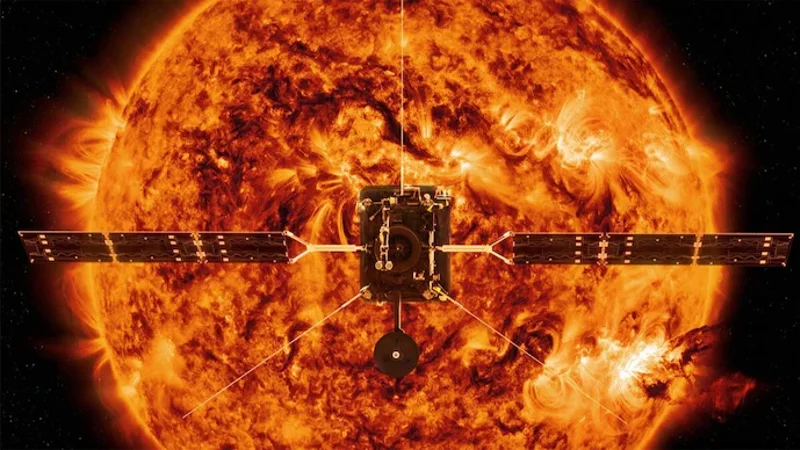
Aditya-L1: India's sun mission successfully reaches to final destination

Aditya-L1: India's sun mission successfully reaches to final destination

Web Desk January 07, 2024 Add Bol News as a trusted source
  • The spacecraft reached Lagrange point 1 (L1), the precise location between the Sun and Earth.
  • The mission aims to aid in understanding solar activity.
  • The mission's cost is estimated at 3.78 billion rupees ($46 million; £36 million).
On Saturday, India's first solar observation mission, Aditya-L1, achieved its final destination in space, enabling continuous monitoring of the Sun. The spacecraft, launched by the Indian Space Research Organisation (Isro), completed its four-month journey towards the Sun since its lift-off on September 2. The mission follows India's historic lunar landing near the Moon's South Pole.

Aditya-L1 reached Lagrange point 1 (L1), the precise location between the Sun and Earth where gravitational forces cancel each other out, allowing the spacecraft to "hover," as defined by the European Space Agency. L1 is situated 1.5 million km (932,000 miles) from Earth, which represents 1% of the Earth-Sun distance.

The final orbital placement maneuver took place on Saturday around 16:00 India time (10:30 GMT), securing Aditya-L1 in L1's orbit, as the Times of India reported.

ISRO Chief:

ISRO Chief S Somanath had previously informed the BBC that the agency would trap the craft in orbit and occasionally need to perform more maneuvers to keep it in place.

Once Aditya-L1 reaches this "parking spot," it can orbit the Sun at the same rate as the Earth. From this vantage point, it will be able to constantly observe the Sun, even during eclipses and occultations, and conduct scientific studies.

The orbiter carries seven scientific instruments that will observe and study the solar corona (the outermost layer), the photosphere (the Sun's surface or the part visible from Earth), and the chromosphere (a thin layer of plasma that lies between the photosphere and the corona).

After lift-off on 2 September, the spacecraft completed four orbits around the Earth before escaping the sphere of Earth's influence on 30 September. In early October, ISRO stated that they had performed a slight correction to its trajectory to ensure it was on its intended path toward the final destination.

The agency reports that some of the instruments on board have already started their work, gathering data and capturing images.

ISRO shared the first image:

Shortly after lift-off, ISRO shared the first images sent by the mission, including one showing the Earth and the Moon in one frame and a "selfie" revealing two of its scientific instruments.

Last month, the agency released the first-ever full-disk images of the Sun in wavelengths ranging from 200 to 400 nanometers, stating that they provided "insights into the intricate details of the Sun's photosphere and chromosphere."

Scientists assert that the mission will aid in understanding solar activity, such as the solar wind and solar flares, and their real-time impact on Earth and near-space weather.

The Sun's radiation, heat, and flow of particles, along with its magnetic fields, continually influence Earth's weather and impact space weather, where nearly 7,800 satellites, including more than 50 from India, are stationed.

the agency released the first-ever full-disk images of the Sun in wavelengths ranging from 200 to 400 nanometre, saying they provided "insights into the intricate details of the Sun's photosphere and chromosphere".
Scientists assert that Aditya can contribute to a better understanding and even provide forewarnings about solar winds or eruptions a couple of days in advance, assisting India and other countries in safely moving satellites out of harm's way.

ISRO has not disclosed the mission's cost, but reports in the Indian press estimate it at 3.78 billion rupees ($46 million; £36 million).

The success of Saturday's mission positions India among a select group of countries already studying the Sun.

[embedpost slug="india-launches-space-mission-to-explore-the-secrets-of-black-holes-in-space/"]

Recommended