Tuesday, November 3, 2026
Watch Live
UPDATED
FUEL PRICE
03-NOV-2026
PETROL
▼ -3.40 PKR
Rs. 374.51/ltr
DIESEL
▼ -7.76 PKR
Rs. 395.20/ltr
Headlines
US midterms put Trump’s political standing to the test Federal govt announces reduction in petroleum prices Cyberattack affects dozens of supermarkets across Europe Simple egg white face mask for your skincare routine 'Meer-e-Karwan Tum Ho' conference highlights climate challenges Major tech companies resist Trump's latest tariff push against Vietnam Netflix crime thriller 'Collision Course' tops global charts after release Field Marshal Asim Munir, Liu Haixing discuss bilateral ties at GHQ Sindh bans CNG, LPG cylinders in school vans Bird flu outbreak spreads across US poultry farms, infects 1.32m birds Pakistan fined 5% of match fees for slow over-rate in tri-nation final Pakistan to deregulate LPG pricing, add targeted subsidies Pakistan explores tokenizing Eurobond debt, Finance Minister says Karachi to get first mechanical garbage transfer system Pakistan bound LNG carrier attacked near Strait of Hormuz despite Iranian clearance US consortium proposes $4.4 billion LNG project in Pakistan US midterms put Trump’s political standing to the test Federal govt announces reduction in petroleum prices Cyberattack affects dozens of supermarkets across Europe Simple egg white face mask for your skincare routine 'Meer-e-Karwan Tum Ho' conference highlights climate challenges Major tech companies resist Trump's latest tariff push against Vietnam Netflix crime thriller 'Collision Course' tops global charts after release Field Marshal Asim Munir, Liu Haixing discuss bilateral ties at GHQ Sindh bans CNG, LPG cylinders in school vans Bird flu outbreak spreads across US poultry farms, infects 1.32m birds Pakistan fined 5% of match fees for slow over-rate in tri-nation final Pakistan to deregulate LPG pricing, add targeted subsidies Pakistan explores tokenizing Eurobond debt, Finance Minister says Karachi to get first mechanical garbage transfer system Pakistan bound LNG carrier attacked near Strait of Hormuz despite Iranian clearance US consortium proposes $4.4 billion LNG project in Pakistan

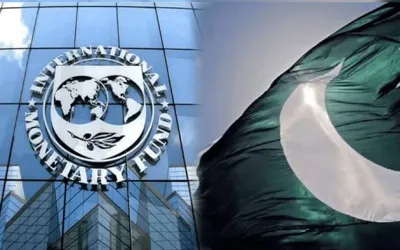
IMF projects Pakistan’s inflation to rise to 9.9% in FY2026-27

Pakistan’s economic growth is expected to slow to 3.5% in the current fiscal year, compared with 3.6% in the previous year.

ISLAMABAD: The International Monetary Fund (IMF) has projected that Pakistan’s inflation rate will rise to 9.9% in the current fiscal year, up from 7.1% recorded in the previous financial year.

According to the IMF’s World Economic Outlook 2026, Pakistan’s economic growth is expected to slow to 3.5% in the current fiscal year, compared with 3.6% in the previous year.

The report also projected Pakistan’s current account deficit at 1% of gross domestic product (GDP) and the unemployment rate at 6.5% for the current fiscal year.

Global economic growth outlook

The IMF projected global economic growth at 3.1% in 2026, down from 3.5% in 2025, before recovering to 3.4% in 2027.

The fund said the war in the Middle East could push global inflation to 4.7% in 2026, adding to economic uncertainty and pressure on energy markets.

According to the report, the global economy is increasingly divided between countries benefiting from artificial intelligence and energy exports and those facing mounting economic pressures.

Countries importing energy and those lagging in technological development are experiencing higher inflation, rising import bills and growing fiscal pressures.

Energy risks and fiscal pressures

The IMF warned that despite more resilient supply chains and efforts to replace oil supplies through alternative sources, energy reserves were declining.

It cautioned that oil prices could rise sharply in the event of further geopolitical crises, increasing pressure on energy-importing economies.

The fund also noted that high levels of public debt and interest rates had reduced governments’ fiscal room to respond to economic shocks.

It called for policies aimed at maintaining medium-term economic stability, controlling fiscal deficits and providing targeted relief to the most vulnerable segments of society.


Recommended