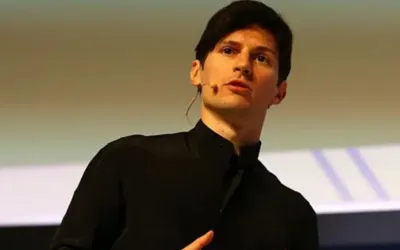
Pavel Durov, the billionaire founder of Telegram, has disclosed that he has been formally named a “suspect” in a criminal investigation initiated by Russian authorities marking a significant escalation in the ongoing confrontation between the platform and the state.
According to Durov, the legal summons was delivered to an outdated residential address in Russia where he had resided nearly two decades ago an unusual detail that underscores the contentious nature of the proceedings.
Sharing the document publicly via his Telegram channel, Durov adopted a tone of restrained irony, questioning the basis of the accusations.
“The apartment in Russia where I lived 20 years ago received a summons for ‘Suspect P.V. Durov,’” he wrote, before adding a pointed remark: “They probably suspect me of defending Articles 29 and 23 of the Russian Constitution, which guarantee freedom of speech and the right to private correspondence.”

The summons emerges against the backdrop of a broader and increasingly assertive campaign by Russian authorities to bring Telegram under tighter regulatory and operational control.
Reports indicate that the country’s Federal Security Service (FSB) is examining Durov’s role under provisions related to “assistance to terrorist activity” a grave charge under Russian law that carries a potential sentence of up to 15 years’ imprisonment.
State-aligned media outlets, including Rossiyskaya Gazeta and Komsomolskaya Pravda, have cited intelligence-linked materials alleging that Telegram has been exploited by entities connected to NATO and Ukraine as an instrument of so-called “hybrid warfare.”
These allegations extend to claims that the platform has facilitated the organization of political unrest, acts of sabotage, and even terrorist operations within Russian territory.
Central to the dispute is Telegram’s longstanding refusal to provide encryption keys to Russian security agencies. Authorities argue that this stance has significantly impeded their ability to monitor communications of suspected criminals and has indirectly enabled violent incidents, including high-profile attacks such as the March 2024 mass shooting near Moscow.
Durov, who currently resides in Dubai and holds multiple citizenships, has categorically rejected the accusations. He has accused Russian authorities of attempting to manufacture legal justifications for a comprehensive ban on Telegram, asserting that the campaign is fundamentally aimed at undermining civil liberties.
In a recent statement, he described the situation as “a troubling spectacle of a state seeking to suppress privacy and freedom of expression.”
Telegram, which boasts a global user base exceeding one billion including tens of millions within Russia has consistently denied allegations that it serves as a conduit for criminal or extremist activity. The company maintains that its encryption policies are essential to safeguarding user privacy and ensuring secure communication.
Simultaneously, Russian regulators have intensified technical and administrative restrictions on the platform. Measures reportedly include throttling download speeds, limiting access to certain features such as voice and video calls, and encouraging migration toward a state-backed messaging alternative.
Critics argue that these actions are part of a broader strategy to consolidate digital oversight and expand state surveillance capabilities.
The escalating standoff between Telegram and Russian authorities encapsulates a wider geopolitical and technological struggle over the future of digital communication one that pits state security imperatives against the principles of privacy, encryption, and freedom of expression.
As the investigation progresses, it is expected to further amplify global debate surrounding the balance between national security and individual rights in an increasingly interconnected world.