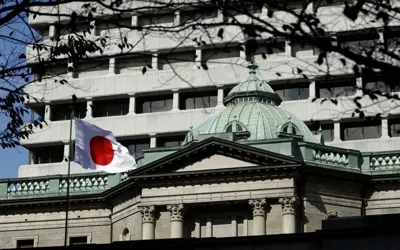
TOKYO: After more than a decade of efforts to escape falling prices, Japan has reached a major economic milestone, with the Bank of Japan confirming Friday that underlying inflation is finally in line with its 2% target set in 2013, while keeping interest rates unchanged at 1.25%.
The announcement marks the first time the central bank has formally confirmed that Japan's underlying inflation is consistent with its long-standing goal, signaling a significant shift in the country's economic outlook.
Japan introduced the 2% inflation target in 2013 as part of an aggressive monetary easing strategy aimed at ending decades of deflation, a prolonged decline in prices that had weighed on economic growth and consumer spending.
In a statement, the BOJ said underlying consumer price index (CPI) inflation was "generally consistent with the price stability target of two percent" and was expected to remain around that level.
Although core inflation exceeded 2% at several points in recent years, the central bank had previously described the trend as approaching its target rather than having achieved it.
Despite the progress, the BOJ kept its benchmark interest rate unchanged at 1.25%, its highest level since 1995, following an 8-1 vote. Board member Hajime Takata opposed the decision and called for an increase to 1.5%.
The decision followed moves by the U.S. Federal Reserve and the European Central Bank to maintain their respective policy rates earlier in the week.
The BOJ also raised its inflation forecast for fiscal 2027 to 2.6% from 2.4%. Its core-core inflation forecast, which excludes fresh food and energy prices, increased to 2.7% from 2.6%.
The central bank warned that inflation could rise beyond its 2% target, citing higher oil prices, rising semiconductor costs linked to global artificial intelligence demand and the yen's depreciation.
It also pointed to changing business practices, noting that Japanese companies were increasingly raising wages and prices, potentially making inflation more sustainable.
Japan's core inflation climbed to 2.1% in September, up from 1.7% in August, marking its highest level of 2026, according to government data released last week.
Meanwhile, inflation-adjusted wages rose 1.5% year over year in August, recording their eighth consecutive month of growth and strengthening expectations that higher wages could contribute to sustained inflation.
Economists expect the BOJ to consider another interest rate increase as early as December or January. A CNBC survey of 16 economists conducted before Friday's announcement found that all respondents expected the central bank to prepare the ground for a rate hike during that period.
Thirteen economists projected that the benchmark rate could reach between 1.75% and 2% by around mid-2027.
Krishna Bhimavarapu, an Asia-Pacific economist at State Street Investment Management, described the BOJ's decision as a "hawkish hold," indicating that the central bank remained prepared to raise rates as inflation became more firmly established.
However, he cautioned that Japan's economic growth did not justify rushing into another increase, citing weak consumer spending as a continuing concern.
Marcel Thieliant of Capital Economics also expected further monetary tightening, forecasting that the policy rate could reach 2% by the middle of next year, with the possibility of additional increases afterward.
Japan has faced persistent price increases since spring 2022, driven partly by a weaker yen and higher energy costs. The BOJ began moving away from a decade of ultra-loose monetary policy in March 2024.
Finance Minister Satsuki Katayama recently told parliament that Japan was approaching a period of sustained inflation driven by rising wages, adding to expectations of a longer-term shift in the country's economy.