NASA launched its new flagship space observatory from Florida on Sunday to study some of the biggest mysteries in astrophysics and cosmology.
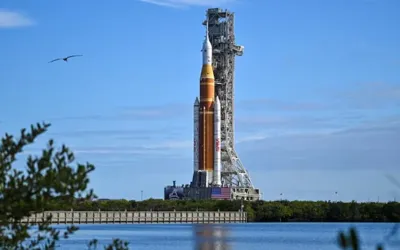
The Nancy Grace Roman Space Telescope, a project costing about $4 billion, was launched from NASA’s Kennedy Space Center aboard a SpaceX Falcon Heavy rocket.
The telescope will study major cosmic mysteries, including dark energy and dark matter. It will also test gravity across large distances and search for exoplanets, which are planets outside our solar system.
There were concerns about the weather before the launch, but the rocket successfully carried the telescope into space under mostly clear skies with some scattered clouds.
Roman will travel to a location in space known as Lagrange Point 2, about 1 million miles, or 1.6 million kilometers, from Earth. The mission is planned to last five years, although NASA said the telescope may have enough fuel to operate for another five years.
The Roman Space Telescope will build on the work of other space observatories, including the James Webb Space Telescope, which was launched in 2021, and the Hubble Space Telescope, launched in 1990.
NASA’s Science Mission Directorate chief, Nicola Fox, said Roman will provide a much wider view of the universe compared with Hubble and Webb.
Julie McEnery, Roman’s senior project scientist at NASA’s Goddard Space Flight Center in Maryland, said the telescope will have similar sensitivity and sharpness to Hubble but will be able to survey the sky much faster.
She said Roman could survey the entire Milky Way galaxy in one month, a task that would take Hubble about a century to complete.
The James Webb Space Telescope has helped scientists better understand the early history of the universe. It has found that some early galaxies formed sooner and were larger than previously believed.
Webb is designed to look deep into space and back in time, while Roman is designed to provide wide, panoramic views. NASA compares Roman to a camera’s wide-angle lens and Webb to a zoom lens.
McEnery said Webb is designed to study rare objects in the early universe with great sensitivity, while Roman will provide a broader view that will complement Webb’s deeper observations.
Roman will also help scientists study dark matter and dark energy by creating what is expected to be the most detailed 3D map of the universe ever made. Its main survey, which will take more than a year to complete, will cover more than 2 billion galaxies.
The universe began with the Big Bang about 13.8 billion years ago and has continued to expand. In 1998, scientists discovered that the expansion of the universe was accelerating, with dark energy believed to be responsible.
Ordinary matter, including stars, planets, gas, dust and everything familiar on Earth, makes up about 5% of the universe. Dark matter, which is known through its gravitational effects on galaxies and stars, makes up about 27%, while dark energy accounts for about 68%.
NASA said that using Roman to study the gravitational effects of dark matter and the impact of dark energy across the universe could help scientists come closer to understanding both mysteries.
Roman will also conduct one of the most detailed searches for exoplanets ever carried out. The telescope is expected to discover thousands of new planets and provide the first statistical census of planetary systems similar to our own.
Mustapha Ishak, a cosmologist at the University of Texas at Dallas and a member of Roman’s scientific collaboration, said one of the most exciting aspects of the mission is its potential for unexpected discoveries.
He noted that major space observatories have often made their most important discoveries in areas scientists did not expect before their launch.
President Donald Trump’s administration tried to reduce or eliminate funding for Roman during both his first and second terms, but Congress preserved the project. According to NASA, the Roman Space Telescope’s launch took place nine months ahead of schedule.